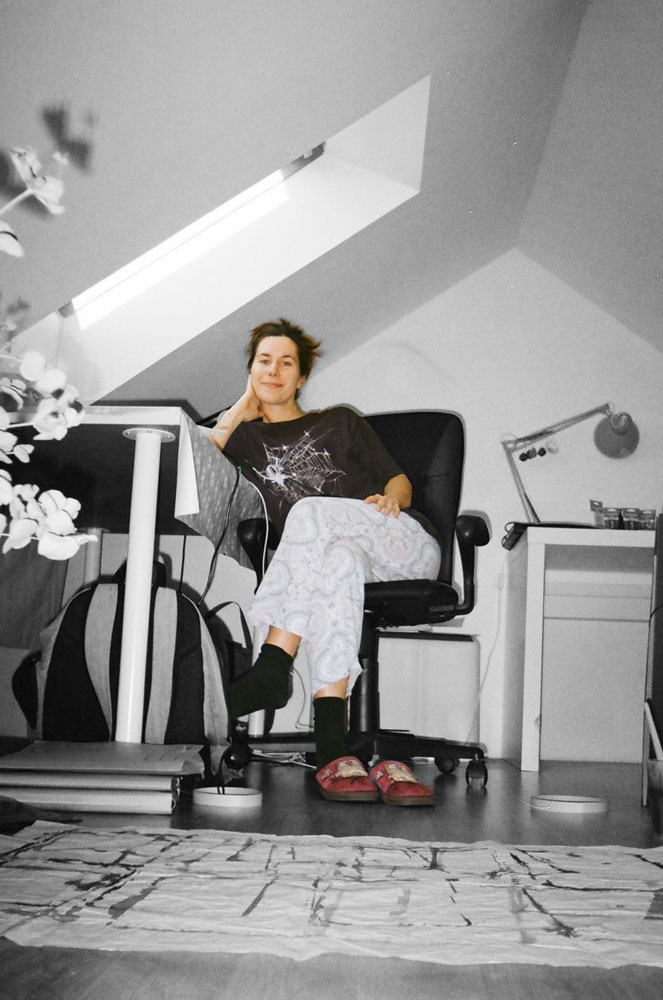

Credits: Apolonija Lučić
Right now, I’m just getting started—and yet, in a way, I’m already right in the middle—of a new storytelling project. Once again, I’m grappling with the same initial questions: What narrative strategy should I pursue? How should the story unfold? Linearly, or perhaps, for now, a loose meandering through images and text? So right now, I’m immersing myself in novels through this lens with admiration, dusting off books on narrative theory once more, and, above all, losing myself in my collection of graphic narratives by my favorite artists. I’m trying to figure out what makes these works so fascinating to me and what allows me to immerse myself so deeply in their narratives. And in that vein, I’d like to introduce you to an artist whose narrative style fascinates me and has made me curious to learn more about her creative process. Apolonija lives and works in Zagreb. But let’s dive right into the interview and let her speak for herself:
Dear Apolonija, I’ve leafed through your story “Silent Observations”—which was published as a mini kuš issue—countless times, and I keep discovering new aspects in the spaces created by your images and text. Your color palette and your unique rhythm truly open up entirely unique imaginary spaces. But how would you describe your own approach (to this project)?
Thank you for your kind words and for the interview invitation. The idea for → Silent Observations existed for a while, but I’m not sure if it would ever come to life if David Schilter from → Kuš! hadn’t invited me to make a ‘longer’ → comic for their mini kuš edition in 2024. Sometimes it takes too much time for me to start working on my own ideas. I’ve been checking now the notebook in which I started writing the story, so the comic actually got developed from the text into the visuals for which I did minimal sketching. The approach was writing the draft text, then the drawing, which lasted for 3-4 months, and afterwards the editing of the text and merging it with the visuals. Parallely, life was going on and in that period I also had a full time job which wasn’t art related so that’s why the process took so long. I wasn’t thinking so much about the drawings – my approach is more intuitive when it comes to the drawing part and the narration happens kind of randomly. Maybe not the best approach if you’re planning to work on something longer—but for now I was always lucky that the image and the text would work together (or maybe I just think they do haha).

I’m always interested in how you generally approach visual stories/comics. What comes first? The visual world? Or do you start with a traditional script?
The process isn’t always the same—but most of the time I did have an idea for the stories. First I would write the draft (without polishing the text), but then I already like to start working on the drawings. In the process of working on drawings I usually edit the story and mix these two together. I write the text with the pencil just to see if it fits the page and then the final part is to scan all the drawings and add text digitally on the tablet. Still love to draw with traditional techniques and don’t like to draw whole pages on a tablet. I never do complete storyboards—plan ahead what is on which page—because I like to change things in the process and I don’t like to pressure myself with some fictional construction I’d have to always follow. Things can spontaneously happen in this weird process.
The latest comic developed from the drawings I did first. Parallely I was writing in the sketchbook and hated the texts. But then I took a sentence or two from all the pages I wrote and somehow reduced it to something that worked. My process is a bit random.
Your work moves between illustration, graphic design, and comics, finding your very own form of visual storytelling in the process. I find that very inspiring. Who are your inspirations?
I would say I work between illustration and comics—graphic design is really not my area and I really don’t find myself comfortable working with typography.
The inspirations for my work usually come from the life itself—some situations or feelings, places, nature or ideas about life that I find intriguing and then I just envision them through comics or whatever else. Sometimes I also like to draw without the pressure to make a story out of it—just because it’s relaxing and kind of meditative.
There’s many areas of art I find inspiring, from visual arts, literature, cinema, theatre etc., and it keeps changing over time. I’m also lucky to be surrounded with talented friends who create different things in various media.
It also happens that I start reading or exploring about certain art movement or artists while working on specific projects. For example, while I was illustrating a book → “Classic Mud Cake and Other Recipes for Nothing from Naught” (written by Goran Ferčec) I was reading and watching a lot of videos about Fluxus because it was also the writer’s inspiration for the story. For the latest comic I made (about flowers), I got a bit obsessed about Georgia O’Keeffe’s painting and thought no one will ever make anything better related to flowers from her.
A book that was really important to me in the past two years was “Brod za Issu” by Robert Perišić (it is translated in English as → “A Cat At the End of the World”). I was reading it at a specific period, and it was just one of those experiences when a piece of art really does something you didn’t expect. Touches you deeply.
What are good places, good spaces for you to work? Do you mainly work alone, or are you part of a collective?
I usually work alone from home (I have a corner in the apartment with a table I use for my work), don’t have a studio at the moment. I never liked working from cafes or bars (to do some computer work for example)—I need solitude and deep concentration to be productive.
I did some projects with my sister Agata, mostly mural painting. I worked with collectives, although I’ve never become a full-time member of any of them. I find it nice not to do everything on your own and to be surrounded with people as this is generally an isolating type of work and you’re mostly sitting with yourself and your ideas, questioning and overthinking both. I did an internship with → Oficina Arara in Porto in 2022–2023, they are an artist collective that works mainly with silkscreen posters, and it was a good experience to see how people who’ve been doing that for more than a decade do it. I also collaborate with friends who have a riso and silkscreen studio in Zagreb, their collective is called → Smak Press. I call them if I want to print something of my own and then we do it together, and I genuinely support the work they do.

What’s your take on the comic book scene? What do you miss? What would you like to see?
I don’t read a lot of comics lately, but I think there’s so many things in the comic book scene that everyone can find something they’re attracted to—more mainstream or something more underground or alternative. I think I don’t miss anything in this variety, just more time, focus and less distractions to read more. But maybe my favorite comic artist at the moment is Olivier Schrauwen, I just enjoy his bizarre storytelling and his drawings are fantastic. I also love the comic Richter’s Game from Dunja Janković in which she transformed the work of the architect Vjenceslav Richter into a whole new comic world. And I would also like to mention the comic → “Abolition of Work” from Bruno Borges and Bob Black that starts with the sentence: “No one should ever work. Work is the source of nearly all the misery in the world. Almost any evil you’d care to name comes from working or from living in a world designed for work. In order to stop suffering, we have to stop working.”
I love the books of → Marjane Satrapi (Persepolis, Chicken with Plums) and Ulli Lust (How I Tried to Be a Good Person, Today Is the Last Day of the Rest of Your Life ). And of the more “underground” scene I love → Ena Jurov, → Sofija Pašalić and → Gonçalo Duarte’s comic work.
What topics interest you in terms of content? Do you feel like certain themes recur?
I guess comics are one of my ways I try to filter life through—what I observe, love, admire, have curiosity about, doubt, stress or get frustrated with—somehow finds a way to get implemented into the work I do, in a subtle way and mixed with fiction. I don’t think I can work if I detach myself from the stories completely, but I also wouldn’t like to make work that is just about me, so I always hope there’s balance in stories I create.
For Silent Observations, the inspiration is quite obvious, struggle with work, with accomplishing financial stability and all these things that are a part of a “grown-up” life, and somehow you’re considered a failure if you still didn’t accomplish the vision that capitalistic world/society has projected on us. The idea was to invent a story in which the main character doesn’t even mention any of this (words like income, finances, house owning, properties, contracts etc.). It’s a utopian world of 24 pages about time and space to observe, and a certain moment in which you detach yourself from all of your material belongings. In a way what is observed naturally becomes the focus of the story, more important than the protagonist itself.
And of course, I’m curious: What are you currently working on? Are you perhaps working on a long-form narrative?
I’ve been trying to find balance between all the things I do, and unfortunately I didn’t create much in the past year. Next month I’ll do a comic residency in Riga, organized by Kuš! and Part-Time Gallery and I will try to use the opportunity to expand the idea of Silent Observations into another story with a different protagonist.
Finally, I always ask this question: What song should everyone have drawn to at least once?
The first thing that came to my mind is “Heaven” by Talking Heads.
Thank you, Apolonija, for your time. Thank you for the inspiring conversation!
→ Here you can see more of Apolonija’s work.

•••
Gerade stehe ich am Beginn und irgendwie doch schon mitten drin in einem neuen Erzählprojekt. Wieder einmal begleiten mich dabei die immer selben Anfangsfragen: Welche Erzählstrategie verfolge ich? Wie soll sich die Geschichte entwickeln? Linear oder doch erst einmal ein loses Wandern und Mäandern durch Bild und Text? Aktuell tauche ich also mit dieser Brille bewundernd in Romane ein, hole noch einmal Bücher zu Erzähltheorien hervor und verliere mich vor allem in meiner Sammlung an Graphischen Erzählungen meiner LieblingskünstlerInnen. Ich versuche zu ergründen, was für mich diese Werke so faszinierend machen und was mich so tief in deren Erzählungen eintauchen lässt. Und in diesem Zuge möchte ich euch eine Künstlerin vorstellen, deren Erzählweise mich fasziniert und mich neugierig gemacht hat, mehr über ihren Arbeitsprozess zu erfahren. Apolonija lebt und arbeitet in Zagreb. Doch lasst uns gleich einsteigen in das Interview und sie direkt zu Wort kommen:
Liebe Apolonija, ich habe deine Erzählung → „Silent Observations“ – die als Mini-Kuš-Ausgabe erschienen ist – schon unzählige Male durchgeblättert und entdecke immer wieder neue Aspekte in den Räumen, die deine Bilder und dein Text schaffen. Deine Farbpalette und dein einzigartiger Rhythmus eröffnen wirklich ganz eigene imaginäre Räume. Aber wie würdest du deinen eigenen Ansatz (bei diesem Projekt) beschreiben?
Vielen Dank für deine freundlichen Worte und die Einladung zum Interview. Die Idee zu „Silent Observations“ gab es schon eine Weile, aber ich bin mir nicht sicher, ob sie jemals umgesetzt worden wäre, hätte mich David Schilter von → Kuš! nicht eingeladen, einen „längeren“ Comic für ihre „mini kuš“-Ausgabe im Jahr 2024 zu zeichnen. Manchmal brauche ich einfach zu lange, um mit der Arbeit an meinen eigenen Ideen zu beginnen. Ich habe mir jetzt nochmal das Notizbuch angesehen, in dem ich angefangen hatte, die Geschichte aufzuschreiben – der Comic entwickelte sich also tatsächlich vom Text hin zu den Bildern, für die ich nur minimale Skizzen angefertigt habe. Mein Vorgehen war folgendes: Zuerst schrieb ich den Textentwurf, dann folgte das Zeichnen, was 3–4 Monate dauerte, und anschließend überarbeitete ich den Text und fügte ihn mit den Bildern zusammen. Parallel dazu lief das Leben weiter, und in dieser Zeit hatte ich auch einen Vollzeitjob, der nichts mit Kunst zu tun hatte – deshalb hat der Prozess so lange gedauert. Über die Zeichnungen habe ich mir nicht allzu viele Gedanken gemacht – mein Ansatz ist beim Zeichnen eher intuitiv, und die Erzählung entsteht irgendwie zufällig. Vielleicht nicht der beste Ansatz, wenn man vorhat, an etwas Längerem zu arbeiten – aber bisher hatte ich immer das Glück, dass Bild und Text gut zusammenpassten (oder vielleicht glaube ich das auch nur, haha).
Mich interessiert immer, wie du generell an visuelle Geschichten bzw. Comics herangehst. Was kommt zuerst? Die visuelle Welt? Oder beginnst du mit einem klassischen Storyboard?
Der Ablauf ist nicht immer derselbe – aber meistens hatte ich schon eine Idee für die Geschichten. Zuerst schreibe ich den Entwurf (ohne den Text zu überarbeiten), aber dann fange ich gerne schon an, an den Zeichnungen zu arbeiten. Während ich an den Zeichnungen arbeite, überarbeite ich in der Regel die Geschichte und verflechte beides miteinander. Ich schreibe den Text mit dem Bleistift, nur um zu sehen, ob er auf die Seite passt, und zum Schluss scanne ich alle Zeichnungen ein und füge den Text digital auf dem Tablet hinzu. Ich zeichne immer noch gerne mit traditionellen Techniken und mag es nicht, ganze Seiten auf einem Tablet zu zeichnen. Ich erstelle nie vollständige Storyboards – also plane ich nicht im Voraus, was auf welcher Seite zu sehen sein soll –, weil ich gerne im Laufe des Prozesses Dinge ändere und mich nicht mit einer fiktiven Struktur unter Druck setzen möchte, an die ich mich immer halten müsste. In diesem seltsamen Prozess können Dinge spontan entstehen.
Der neueste Comic entstand aus den Zeichnungen, die ich zuerst angefertigt hatte. Parallel dazu schrieb ich in mein Skizzenbuch und hasste die Texte. Aber dann nahm ich von allen Seiten, die ich geschrieben hatte, ein oder zwei Sätze heraus und reduzierte sie irgendwie auf etwas, das funktionierte. Mein Arbeitsprozess ist ein bisschen zufällig.

Deine Arbeit bewegt sich zwischen Illustration, Grafikdesign und Comics, wobei du dabei deine ganz eigene Form des visuellen Erzählens gefunden hast. Das finde ich sehr inspirierend. Wer sind deine Vorbilder?
Ich würde sagen, ich bewege mich zwischen Illustration und Comics – Grafikdesign ist wirklich nicht mein Gebiet, und mit Typografie fühle ich mich auch nicht besonders wohl.
Die Inspiration für meine Arbeit kommt meist aus dem Leben selbst – bestimmte Situationen oder Gefühle, Orte, die Natur oder Gedanken über das Leben, die ich faszinierend finde, und die ich dann einfach in Form von Comics oder auf andere Weise umsetze. Manchmal zeichne ich auch gerne, ohne den Druck, daraus eine Geschichte machen zu müssen – einfach, weil es entspannend und irgendwie meditativ ist.
Es gibt viele Bereiche der Kunst, die mich inspirieren, von der bildenden Kunst über Literatur, Kino und Theater usw., und das ändert sich im Laufe der Zeit ständig. Ich habe auch das Glück, von talentierten Freunden umgeben zu sein, die in verschiedenen Medien unterschiedliche Dinge schaffen.
Es kommt auch vor, dass ich mich während der Arbeit an bestimmten Projekten mit einer bestimmten Kunstbewegung oder bestimmten Künstlern beschäftige. Als ich zum Beispiel das Buch → „Classic Mud Cake and Other Recipes for Nothing from Naught“ (Text von Goran Ferčec) illustrierte, habe ich viel über Fluxus gelesen und mir viele Videos dazu angesehen, da dies auch die Inspiration des Autors für die Geschichte war. Für den neuesten Comic, den ich gezeichnet habe (über Blumen), war ich ein wenig besessen von Georgia O’Keeffes Gemälden und dachte, niemand würde jemals etwas Besseres zum Thema Blumen schaffen als sie.
Ein Buch, das mir in den letzten zwei Jahren sehr wichtig war, war „Brod za Issu“ von Robert Perišić (auf Englisch übersetzt als → „A Cat At the End of the World“). Ich habe es zu einer bestimmten Zeit gelesen, und es war einfach eine dieser Erfahrungen, bei denen ein Kunstwerk wirklich etwas bewirkt, womit man nicht gerechnet hat. Es berührt einen zutiefst.
Was sind für dich gute Orte, gute Räume zum Arbeiten? Arbeitest du hauptsächlich allein oder bist du Teil eines Kollektivs?
Ich arbeite normalerweise allein von zu Hause aus (ich habe eine Ecke in meiner Wohnung mit einem Tisch, den ich für meine Arbeit nutze) und habe derzeit kein Atelier. Ich habe es nie gemocht, in Cafés oder Bars zu arbeiten (zum Beispiel, um am Computer zu arbeiten) – ich brauche Einsamkeit und tiefe Konzentration, um produktiv zu sein.
Ich habe einige Projekte mit meiner Schwester Agata durchgeführt, hauptsächlich Wandmalerei. Ich habe mit Kollektiven zusammengearbeitet, obwohl ich nie Vollzeitmitglied eines davon geworden bin. Ich finde es schön, nicht alles alleine zu machen und von Menschen umgeben zu sein, da diese Arbeit im Allgemeinen sehr isolierend ist und man meist mit sich selbst und seinen Ideen alleine da sitzt, wobei man beides hinterfragt und überdenkt. Von 2022 bis 2023 habe ich ein Praktikum bei → Oficina Arara in Porto absolviert, einem Künstlerkollektiv, das hauptsächlich mit Siebdruckplakaten arbeitet. Es war eine gute Erfahrung zu sehen, wie Menschen, die das schon seit mehr als einem Jahrzehnt machen, dabei vorgehen. Außerdem arbeite ich mit Freunden zusammen, die in Zagreb ein Riso- und Siebdruckstudio betreiben; ihr Kollektiv heißt → „Smak Press“. Ich rufe sie an, wenn ich etwas Eigenes drucken möchte, und dann machen wir das gemeinsam, und ich unterstütze ihre Arbeit von ganzem Herzen.
Wie siehst du die Comicszene? Was vermisst du? Was würdest du dir wünschen?
Ich lese in letzter Zeit nicht mehr so viele Comics, aber ich glaube, die Comicszene ist so vielfältig, dass jeder etwas finden kann, das ihn anspricht – sei es eher Mainstream oder eher Underground oder alternativ. Ich glaube, bei dieser Vielfalt vermisse ich eigentlich nichts, nur mehr Zeit, Konzentration und weniger Ablenkungen, um mehr lesen zu können. Aber mein derzeitiger Lieblingscomiczeichner ist vielleicht Olivier Schrauwen – ich genieße einfach seine bizarre Erzählweise und seine Zeichnungen sind fantastisch. Ich liebe auch den Comic „Richter’s Game“ von Dunja Janković, in dem sie das Werk des Architekten Vjenceslav Richter in eine ganz neue Comicwelt verwandelt hat. Und ich möchte auch den Comic → „Abolition of Work“ von Bruno Borges und Bob Black erwähnen, der mit dem Satz beginnt: „Niemand sollte jemals arbeiten. Arbeit ist die Quelle fast allen Elends auf der Welt. Fast jedes Übel, das man sich vorstellen kann, rührt von der Arbeit her oder davon, in einer Welt zu leben, die auf Arbeit ausgelegt ist. Um das Leiden zu beenden, müssen wir aufhören zu arbeiten.“
Ich liebe die Bücher von → Marjane Satrapi („Persepolis“, „Huhn mit Pflaumen“) und → Ulli Lust („Wie ich versuchte, ein guter Mensch zu sein“, „Heute ist der letzte Tag vom Rest deines Lebens“). Und von der eher ‘underground’ Szene liebe ich die Arbeiten von → Ena Jurov, → Sofija Pašalić and → Gonçalo Duarte.
Welche Themen interessieren dich inhaltlich? Hast du das Gefühl, dass bestimmte Themen immer wieder auftauchen?
Ich denke, Comics sind eine der Möglichkeiten, durch die ich versuche, das Leben zu filtern – was ich beobachte, liebe, bewundere, worüber ich neugierig bin, woran ich zweifle, was mir Stress bereitet oder mich frustriert – all das findet irgendwie Eingang in meine Arbeit, auf subtile Weise und vermischt mit Fiktion. Ich glaube nicht, dass ich arbeiten könnte, wenn ich mich komplett von den Geschichten distanzieren würde, aber ich möchte auch keine Werke schaffen, in denen es nur um mich geht; deshalb hoffe ich immer, dass in den Geschichten, die ich erschaffe, ein Gleichgewicht herrscht.
Bei „Silent Observations“ ist die Inspiration ziemlich offensichtlich: der Kampf mit der Arbeit, mit dem Erreichen finanzieller Stabilität und all diesen Dingen, die Teil eines „Erwachsenenlebens“ sind – und irgendwie gilt man als Versager, wenn man die Vision, die uns die kapitalistische Welt bzw. Gesellschaft auferlegt hat, noch nicht verwirklicht hat. Die Idee war, eine Geschichte zu erfinden, in der die Hauptfigur all das (Begriffe wie Einkommen, Finanzen, Wohneigentum, Immobilien, Verträge usw.) nicht einmal erwähnt. Es ist eine utopische Welt auf 24 Seiten, in der es um Zeit und Raum zum Beobachten geht und um einen bestimmten Moment, in dem man sich von all seinen materiellen Besitztümern löst. In gewisser Weise rückt das, was beobachtet wird, ganz natürlich in den Mittelpunkt der Geschichte und wird wichtiger als die Protagonistin selbst.

Und natürlich bin ich neugierig: Woran arbeitest du gerade? Arbeitest du vielleicht an einer längeren Erzählung?
Ich habe versucht, ein Gleichgewicht zwischen all meinen Aktivitäten zu finden, und leider ist im letzten Jahr nicht viel dabei herausgekommen. Nächsten Monat werde ich an einer Comic-Residenz in Riga teilnehmen, die von Kuš! und der Part-Time Gallery organisiert wird, und ich werde versuchen, diese Gelegenheit zu nutzen, um die Idee von „Silent Observations“ zu einer weiteren Geschichte mit einer anderen Hauptfigur auszubauen.
Zum Schluss stelle ich immer diese Frage: Zu welchem Song sollte jeder mindestens einmal gezeichnet haben?
Das Erste, was mir in den Sinn kam, ist „Heaven“ von den Talking Heads.
Danke dir Apolonija für deine Zeit, Danke dir für das inspirierende Gespräch!
→ Hier seht ihr mehr von Apolonijas Arbeiten.
Credits Bilder: Apolonija Lučić